
Installing a battery at home sounds straightforward until we ask a practical question: what exactly should the battery do? Some households want to use more of their solar electricity after sunset, while others mainly want selected appliances to keep running during an outage. Those goals can require very different system designs.
Our approach starts with the household rather than the battery. Electricity consumption, solar production, backup priorities, inverter compatibility, and installation conditions should determine the storage configuration. That sequence helps prevent the common mistake of choosing a battery first and trying to make the rest of the system fit afterward.
How Much Battery Capacity Does Your Home Actually Need?
Battery sizing should begin with electricity consumption. Review when the home uses power, how much energy is consumed during the evening, and which loads would need to remain available during an outage
Daily energy and instantaneous power are separate measurements. A refrigerator may consume modest energy over a day but still require sufficient inverter power when its compressor starts. Meanwhile, several lights and networking equipment may need little power but could remain active for many hours.
The right capacity therefore depends on the intended job. A household seeking evening self-consumption may size around its post-solar demand, while a homeowner prioritizing backup may calculate the energy required by essential loads over the desired outage period.
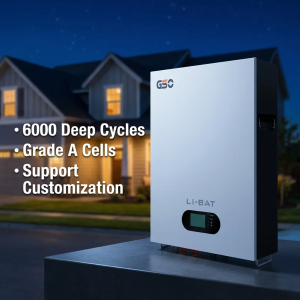
The GBP-W residential battery range provides different nominal capacities, from 2.56 kWh to 10.24 kWh depending on the model. Parallel connection is also available for expanding capacity. These figures are product-specific rather than a universal sizing recommendation.
What Happens to Your Solar Power After Sunset?
Solar panels and household demand rarely follow the same schedule. Production generally occurs during daylight, while cooking, lighting, entertainment, and other household activities can continue after solar generation falls.
A battery changes the timing of that electricity. Surplus solar power can charge the battery during periods of available generation, and the stored energy can later be discharged to support household loads.
That makes solar battery storage more than an emergency reserve. It can become part of the home’s daily energy-management strategy by shifting some available solar electricity from one part of the day to another.
The exact operating strategy depends on the inverter and system controls. The GBP-W product information describes solar charging during daylight as well as grid charging during low-tariff periods, giving the system more than one possible charging source.
For a homeowner, the useful question is therefore not simply whether the battery can store solar power. It is whether its charging and discharging behavior matches the home’s actual electricity schedule.
Which Loads Should Stay On During a Blackout?
Backup planning becomes much clearer once essential loads are separated from non-essential ones. Keeping a refrigerator, lights, router, security equipment, and selected outlets operating is a different requirement from powering every appliance in the house.
Energy capacity determines how long those loads can operate, while inverter output determines how much power can be supplied simultaneously. Both numbers matter.
Large heating or cooling equipment can quickly change the power requirement. If several high-demand appliances must operate together, the inverter needs to be designed accordingly. If the priority is simply keeping essential circuits active, a smaller backup configuration may be sufficient.
Backup switching of under 10 milliseconds is available with hybrid-inverter integration. This specification applies specifically to this product and should not be assumed for other residential batteries.
A practical design therefore starts by writing down the loads that genuinely need electricity during an outage. That list is often more useful than choosing storage according to the total size of the house.
Can Your Existing Inverter Work With the Battery?
Compatibility is one of the first technical checks to make before buying a battery. A storage unit must operate within the electrical and communication requirements of the inverter that controls the system.
Voltage range is one part of the equation. Communication is another. The battery and inverter may need to exchange information about state of charge, charging limits, discharging conditions, and protection status.
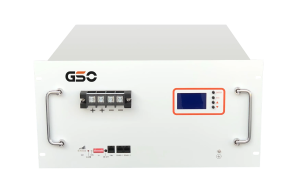
An LCD interface and a pre-loaded inverter protocol library are included. Supported inverter brands include Growatt, Deye, Voltronic, Victron, SolarEdge, Sofar, Solis, Sol-Ark, and GoodWe, with custom protocol support also available.
Existing-system owners should verify the exact inverter model rather than relying only on brand-level compatibility. Battery voltage, communication protocol, charge and discharge settings, and firmware or commissioning requirements can all affect whether a particular combination is appropriate.
Where Will the Battery Live—and What Does That Change?
Residential storage also has a physical dimension. The available wall area, wiring route, accessibility, environmental conditions, and required clearances can influence which battery architecture makes sense.
A wall-mounted design can be useful where preserving floor space matters. The GBP-W series is presented as a wall-mounted residential battery, with a front-facing design intended to support installation and operation. Its published protection rating and environmental specifications still need to be considered when selecting the actual installation location.
Temperature is another practical issue. The supplied product information gives an operating range of -30°C to 60°C and recommends 10°C to 35°C for operation. These are manufacturer specifications for the referenced product, so installation should follow the applicable product documentation rather than applying them universally to all batteries.
Easy access matters too. A battery may remain installed for years, making routine inspection, cable access, and system visibility worth considering before the final mounting position is chosen.
When Is a Larger Battery Actually Worth It?
More capacity is not automatically better. A larger battery only becomes useful when the home can regularly use, store, or reserve that additional energy.
Suppose a household has limited evening consumption. Adding substantially more storage may leave capacity underused. A different household with high nighttime demand and sufficient daytime solar production may benefit much more from additional capacity.
Expansion can make the decision easier. Instead of installing the largest possible battery immediately, a modular architecture may allow capacity to increase when household electricity demand changes. The GBP-W range supports parallel connection, making expansion part of the system design rather than an afterthought.
We would therefore compare the cost and usefulness of additional capacity against actual consumption patterns. A battery should spend much of its useful capacity doing meaningful work rather than simply increasing the headline kWh number.
A Home Battery Should Follow Your Energy Pattern
Good home storage planning works backward from the way the house consumes electricity. First identify the loads and their timing. Next determine how much solar energy is available for charging and how much stored energy is useful after sunset. Then define the circuits that require backup and the power they demand.
Only after those questions are answered should the battery capacity, inverter configuration, communication requirements, and physical format be selected.
Although the biggest unit on the market may seem like the best option for consumers looking into battery backup for home usage, a smaller modular battery might be the better fit. Considerations such as operating requirements, power consumption patterns, storage capacity of solar energy, and compatibility with the current electrical system should be taken into account when making the final decision.
At GSOpower, we take all these considerations into account collectively—and our residential battery architecture is a clear example of that. The storage system’s compatibility with the home is affected by capacity options, LiFePO4 chemistry, inverter communication, modular extension, and wall-mounted construction.
Instead of being viewed as a separate electrical appliance, home battery storage for solar should be viewed as an integrated energy management system. There is a substantial improvement in backup expectations, system integration, and operation once the battery tracks the real energy pattern of the family. This also makes size much more reasonable.