
A buyer searching for the best home battery for solar in 2026 is usually not looking for a battery with the biggest number on its datasheet. The real decision is narrower: which battery can store useful solar surplus, provide the required backup, connect to the existing inverter, and fit the available space?
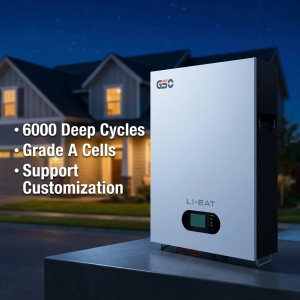
We would make that decision in a different order from a typical product ranking. Start with the household’s electricity pattern, then test each battery against the jobs it must perform. The GBP-W Powerwall gives us a practical reference because its specifications cover several capacities, wall mounting, inverter protocol selection, and parallel expansion.
Which battery fits the way your solar is actually used?
Solar production and household demand rarely peak at the same moment. A home can generate substantial electricity during daylight while using more after work, making stored energy useful later in the day.
That makes the first comparison a timing question rather than a capacity question. If excess solar is modest, a smaller battery may be enough. If the home routinely produces a larger daytime surplus, more storage can capture more of that energy.
The GBP-W series offers six configurations from 2.56 kWh to 10.24 kWh of nominal energy, using 25.6 V, 48 V, or 51.2 V nominal voltage depending on the model. We would compare the model against the household’s actual solar surplus instead of automatically choosing the largest version.
How much of the house really needs to stay powered?
Solar storage and outage protection overlap, but they are not identical jobs. Someone wanting battery backup for home should identify the loads that genuinely need to remain operational when the grid fails.
Refrigeration, lighting, internet equipment, security systems, and selected appliances may have different priorities. Their combined demand determines the power requirement, while outage duration and energy consumption determine required storage.
A 10 kWh battery should not be interpreted as ten hours of backup without knowing the load. A constant 1 kW demand would theoretically consume 10 kWh in ten hours before system losses and operating limits. Real runtime depends on the actual load profile.
Standard charge and discharge current is 0.5C, with a maximum continuous current of 1C and customization options available. Cycle life exceeds 5,000 cycles at 80% depth of discharge.
Those figures are useful comparison points, but we would read them alongside the inverter specification and intended loads. A battery with enough stored energy may still be unsuitable if its available power does not match the home’s requirements.
Which batteries can actually work with the solar system?
A strong candidate can be eliminated immediately if it does not integrate with the home’s inverter. Voltage range, charging and discharge limits, communication protocols, and operating modes should be checked before comparing price.
The GBP-W series uses a pre-loaded inverter protocol library. Supported inverter brands include Growatt, Deye, Voltronic, Victron, SolarEdge, Sofar, Solis, Sol-Ark, and GoodWe, with brand selection available through the battery’s LCD interface. Exact compatibility should still be confirmed for the specific inverter model.
This matters because battery storage is not a standalone appliance. The battery, inverter, solar array, and household loads form one operating system. For us at GSOpower, inverter communication is therefore part of product selection rather than an installation detail to investigate afterward.
Does the battery suit the room as well as the electrical system?
A suitable battery still has to occupy a suitable location. Wall-mounted equipment can be valuable where floor space is limited, while modular expansion matters when today’s storage requirement may not be the final one.
The GBP-W is a wall-mounted series designed to mount flat against the wall. Its published maximum dimensions vary by configuration, reaching 682 × 465 × 276 mm for larger models. The series also supports parallel expansion with automatic addressing.
Operating conditions should be checked before installation. The specification gives an IP20 protection level, natural-air cooling or intelligent fan cooling, and a recommended operating temperature of 10–35°C. Charging and discharging are specified from -10°C to 55°C.
A battery that fits electrically but cannot be installed in an appropriate environment is not a practical choice. This matters for battery backup for home projects, where wall space and installation conditions can constrain the final configuration.
So which home battery deserves the shortlist in 2026?
Our comparison would finish with documented fit rather than a universal ranking. Check usable energy against solar surplus, match power capability to the loads, verify inverter communication, measure installation space, and decide whether future expansion matters.
When looking for the best home battery for solar, the GBP-W should be considered if the project calls for a wall-mounted LiFePO4 configuration, different capacity choices, inverter protocol selection, and parallel expansion. Details on certifications such as CE, MSDS, and UN38.3 may be found on the product site as well.
Rather than depending just on marketing jargon, GSOpower’s public product data provides purchasers with tangible parameters to compare. Before placing an order, we would thoroughly assess the home’s load profile and the entire battery-inverter system.
The strongest choice in 2026 is not necessarily the battery with the highest capacity or longest advertised cycle life. It is the one whose energy, power, integration, installation, and expansion characteristics line up with the household’s real operating requirements. We at GSOpower can then be evaluated on those measurable criteria, rather than on a generic “best battery” label.