

Installing commercial battery storage is not simply a matter of placing battery modules in a rack and connecting cables. The system has to match the facility’s load, inverter or PCS, electrical architecture, installation environment, and maintenance workflow. We approach the project as a complete operating system, because decisions made before installation directly affect commissioning and long-term service.
What Needs to Be Decided Before the Rack Arrives
Capacity is the first question, but it should be answered through the site’s energy behavior rather than a standard battery size. Determine how much energy the facility needs to shift, how long critical loads must operate during an outage, and what peak demand the storage system is expected to address.
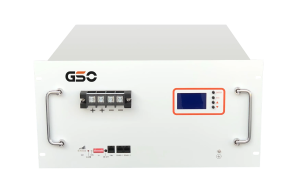
The referenced GBP-R Series includes rack-mounted LiFePO4 battery models ranging from 2.56 kWh to 16.1 kWh per unit, depending on the selected model. Configuration examples are also available for combining modules into larger systems.
Physical planning comes next. Engineers should confirm rack dimensions, cable routing, service access, battery placement, environmental conditions, and the location of the inverter or PCS before the equipment arrives. A technically suitable battery can become difficult to operate if the installation leaves insufficient access for inspection or maintenance.
How a Commercial Rack Battery Goes From Delivery to Operation
Commissioning begins after the mechanical installation, but the battery does not operate independently. Power connections, communication wiring, battery addressing, inverter settings, and protection parameters all have to correspond with the selected architecture.
The GBP-R Series provides CAN/RS485 communication interfaces and an LCD interface for selecting inverter communication protocols. We state compatibility with major inverter brands and support automatic addressing for multiple connected battery units.
The product architecture supports parallel connection of up to 16 units, with the stated configuration allowing total capacity to scale from 2.56 kWh to more than 256 kWh.
We would still verify the exact battery model, inverter or PCS, communication protocol, voltage range, and commissioning procedure before energizing the system. Shared communication standards do not automatically guarantee that every battery and inverter combination is compatible.
What Engineers Actually Maintain After Commissioning
Maintenance starts with knowing what the battery is doing. Monitoring battery status, temperature, alarms, and operating conditions can reveal abnormal behavior before engineers need to investigate the physical equipment.
The referenced rack battery includes an LCD display that provides real-time status information and fault-code visibility. Its front-access design also allows engineers to work on wiring and service points without removing the battery from the rack.
Physical inspection remains necessary. Maintenance teams should follow the manufacturer’s procedures for electrical connections, enclosure condition, cooling arrangements, and environmental conditions. The GBP-R specification describes natural-air cooling or intelligent fan cooling and gives an operating temperature range of -30°C to 60°C, with 10°C to 35°C recommended.
For commercial battery storage, the most useful maintenance approach combines electronic monitoring with scheduled physical inspection. Neither one should be treated as a substitute for the other.
Which Problems Can Be Diagnosed Without Removing the Rack?
A modular system becomes easier to service when engineers can identify the affected component before carrying out extensive physical work. Fault codes, operating data, and communication status can provide an initial indication of whether the issue is associated with the battery, inverter interface, or operating conditions.
The BMS provides another layer of protection and diagnosis. The GBP-R Series documentation describes safeguards including over-temperature protection, over-charge and over-discharge protection, and short-circuit protection.
What Should Engineers Check First?
Start with the displayed fault code and operating condition. Check whether the issue affects one module or multiple units, then review communication status and relevant inverter or PCS alarms. Only after identifying the likely cause should service personnel proceed with the manufacturer’s troubleshooting procedure.
Repeatedly resetting a fault without understanding its cause is not a maintenance strategy. Electrical isolation and repair should be performed according to the manufacturer’s procedures by appropriately qualified personnel.
Why Does Front Access Matter?
Serviceability becomes increasingly important as the number of battery modules increases. Front-access wiring and accessible status information can reduce the need to dismantle a rack simply to identify or reach a service point.
That design consideration is particularly relevant to commercial battery storage solutions because downtime can affect an entire facility’s energy-management strategy. A system that provides useful fault information at the module level can make diagnosis more targeted.
How Capacity Changes When the Business Grows
Commercial energy requirements rarely remain completely static. A facility may add production equipment, increase operating hours, expand its solar installation, or change its backup requirements. Storage architecture should account for the possibility of these changes without assuming that every project needs maximum capacity on day one.
The GBP-R Series supports parallel expansion, with automatic addressing for up to 16 units. This modular approach allows additional battery capacity to be integrated into the same general architecture when the system design and power-conversion equipment support the expansion.
Does Adding Another Battery Require More Than Rack Space?
Yes. Expansion should be checked at the system level. The inverter or PCS must support the increased battery configuration, while cables, protection devices, communication settings, and rack capacity must remain appropriate.
For that reason, future expansion is best considered during the original design. Leaving a physical space for another module does not by itself guarantee that the electrical system can accommodate it later.
Questions Worth Settling Before You Sign Off the System
How Should Commercial Battery Capacity Be Calculated?
Start with the facility’s load profile and the reason for installing storage. Peak shaving, solar self-consumption, and backup can produce different capacity requirements. We offer example configurations for reference, but we recommend sizing the final system according to the specific project requirements.
What Battery Chemistry Does the Rack Use?
The referenced GBP-R Series uses LiFePO4 cells. Cycle life exceeds 5,000 cycles at 80% depth of discharge, with a 10-year life specification. These figures should be interpreted according to the manufacturer’s specified operating conditions rather than as universal guarantees.
How Is the Battery Connected to the Inverter?
The system provides CAN/RS485 communication and allows inverter communication protocol selection through its interface. Exact compatibility should be verified against the specific inverter or PCS model selected for the project.
Can the System Be Expanded Later?
The referenced rack architecture supports parallel connection of up to 16 units with automatic addressing. Whether a particular installation can be expanded depends on the inverter or PCS, protection system, wiring, and other project constraints.
We at GSOpower approaches commercial storage as a lifecycle project rather than a battery-only purchase. Installation, communication, monitoring, service access, and expansion all influence how useful the equipment will be after commissioning.
The practical lesson is straightforward: a commercial battery should be designed for the facility it will serve and the engineers who will maintain it. Capacity determines how much energy can be stored, but installation quality, communication, monitoring, protection, and serviceability determine how effectively that storage can operate in the real world.
For organizations evaluating commercial battery storage solutions, the strongest starting point is therefore not a product catalog. It is a clear project specification covering load requirements, operating objectives, installation conditions, inverter or PCS compatibility, maintenance access, and future expansion.