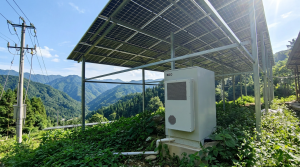

Commercial battery storage is no longer simply a large battery placed beside a building. A complete system can coordinate batteries, battery management, power conversion, energy management, protection equipment, solar generation, the grid, and facility loads. The right architecture depends on what the business wants the system to accomplish.
We approach commercial storage by looking at the entire energy path. Once the components, configurations, operating process, and business objectives are connected, it becomes much easier to understand which commercial battery storage solutions make sense for a particular facility.
What Does a Commercial Battery Storage System Actually Include?
At the center is the battery bank, which stores electricity as electrochemical energy. Lithium iron phosphate, or LiFePO4, is one chemistry used in commercial storage because it can be configured into modular battery packs for stationary applications.
The battery is supported by a Battery Management System, or BMS. Its job includes monitoring battery conditions and managing protection functions. The referenced GBP-R product, for example, specifies protection against conditions including over-temperature, over-charge, and over-discharge.
Power conversion equipment provides the electrical bridge between the battery’s DC electricity and the facility’s AC system. Depending on the project, this role may be performed by a PCS, hybrid inverter, or another suitable power-conversion architecture.
An energy management system can then determine when the battery should charge or discharge according to the site’s operating strategy. Protection equipment, communications, and grid or load connections complete the broader system.
Three Commercial Storage Configurations You Will Commonly Encounter
Commercial storage does not have one universal physical format. The architecture normally follows the project’s required capacity, available space, maintenance approach, and expansion plan.
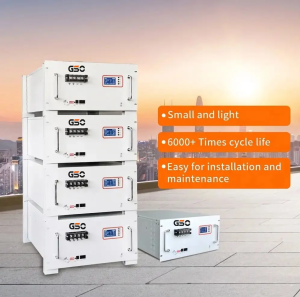
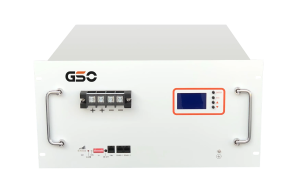
Rack-mounted systems divide storage into individual battery modules installed within a rack. This format can be practical for projects that value modular capacity and service access. The GBP-R series uses this architecture and offers multiple battery configurations, including 48 V and 51.2 V nominal options.
Integrated battery cabinets package battery modules and supporting components into a dedicated enclosure. Such systems can simplify deployment where the project benefits from a more self-contained installation.
Containerized BESS places a much larger energy-storage system within a containerized structure. This architecture is suited to projects where substantial capacity, dedicated infrastructure, and scalable deployment are required.
These formats should not be viewed as a simple small-to-large hierarchy. A rack system can be the better choice for a modular C&I installation, while a containerized system may make more sense for a larger energy project with different site requirements.
What Happens Inside the System During a Normal Operating Day?
The easiest way to understand commercial storage is to follow the electricity.
During a period of solar surplus, PV electricity can supply the facility’s immediate loads while available excess energy is directed toward battery charging. If solar production is insufficient, stored DC energy can move through the PCS or inverter and become AC power for the facility.
Grid electricity can also participate in the operating strategy, depending on the system design and applicable operating rules. A facility may charge the battery during a selected period and discharge it later when electricity demand or energy-management objectives make stored power more useful.
The BMS continuously monitors the battery while the control system determines the intended operating state. Communications between the battery and power-conversion equipment are therefore important. CAN and RS485 interfaces are available for communication with compatible equipment.
In practical terms, the system is constantly managing three questions: where electricity is coming from, where it should go now, and whether some of it should be stored for later.
Where Does the Commercial Value Come From?
The financial and operational value of storage comes from changing the timing and availability of electricity.
Peak management is one example. If a facility experiences short periods of high demand, a battery can be dispatched to provide part of the required power, subject to the system’s configuration and operating strategy.
Solar energy shifting works differently. Instead of using all available PV electricity immediately, surplus generation can be stored and later discharged when solar production decreases. This can increase the amount of locally generated electricity available to the facility.
Load shifting applies the same principle without requiring solar. Stored energy can be used during a different period from when it was charged, depending on electricity tariffs and the site’s operating strategy.
Backup creates another form of value. Critical loads can be supported by stored energy during a grid interruption when the system has been specifically designed for that operating mode.
The benefit is therefore not simply “having a battery.” The value appears when the system changes how the facility obtains and uses electricity.
Why Rack-Mounted LiFePO4 Can Be a Practical C&I Building Block
Rack-mounted batteries are particularly interesting for C&I projects because capacity can be assembled from repeatable modules. Instead of designing every project around one fixed battery block, additional modules can form part of the system architecture.
Our GBP-R Series includes models ranging from 2.56 kWh to 16.1 kWh per battery. The series supports parallel connection of up to 16 units, with automatic addressing, allowing the published configuration to scale beyond 256 kWh under the stated system arrangement.
The modular format also affects maintenance. Front-access wiring and an LCD interface are specified for the referenced series, while CAN and RS485 communications support integration with compatible equipment.
We specify more than 5,000 cycles at 80% depth of discharge and a stated 10-year service life for the series. These figures represent our published specifications and should be evaluated against actual operating conditions, system design, and the relevant product documentation.
How Do You Know Which Commercial Storage Solution Fits Your Site?
Start with the facility’s load profile. Identify the normal demand pattern, peak periods, operating hours, critical loads, and any significant changes expected in the future.
Next, separate power from energy. Required power determines how much output the system must provide at a given moment. Required energy determines how long the battery needs to sustain that operating state.
Then define the primary objective. A system designed mainly for solar shifting may require a different operating strategy from one intended primarily for peak management or backup.
Physical deployment comes afterward. Available floor or rack space, maintenance access, environmental conditions, electrical infrastructure, and expansion plans all influence the appropriate architecture.
Finally, verify communication and power-conversion compatibility before committing to the battery configuration. A technically suitable battery still needs to operate correctly with the PCS, inverter, controls, and protection equipment surrounding it.
Commercial Storage Works Best When the Battery Is Part of the Energy Strategy
The three elements in the title are closely connected. Types describe how the storage system is physically and electrically organized. How it works describes the movement and control of energy between generation, storage, grid, and loads. Benefits appear when that control solves a real operational requirement.
We at GSOpower demonstrate, through our rack-mounted LiFePO4 approach, how modular batteries, BMS protection, communications, and scalable capacity can form part of a broader C&I energy-storage architecture.
For businesses evaluating commercial battery storage solutions, the best starting point is therefore not the largest battery or the longest feature list. Define the site’s energy problem first, determine the required power and capacity, then select the physical and electrical architecture that can solve it.
A well-designed commercial storage system earns its place by controlling energy at the right time and in the right direction. The battery provides the stored energy, but the surrounding system determines how effectively that energy serves the business.