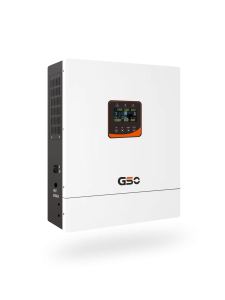

Selecting a 50K Hybrid Inverter involves more than checking its headline rating. A commercial or industrial site must match the inverter to its three-phase service, PV array, battery bank, loads, and environment. This guide covers 50kVA capability, key specifications, and how a three phase hybrid inverter supports demanding facilities.
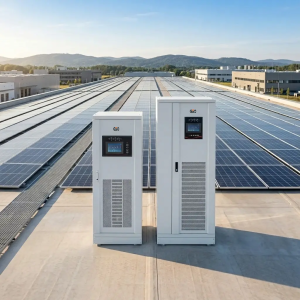
What the 50K rating means
The 50K label generally refers to output of about 50kVA. That is apparent power; usable active power depends on load power factor. Motors, transformers, pumps, and variable-speed drives may draw reactive power, so review both kVA and kW.
A three phase hybrid inverter distributes AC across three coordinated phases for factories, substations, communication facilities, remote sites, and three-phase buildings. Balanced loading prevents one phase reaching its limit prematurely. Follow site voltage, neutral, grounding, and utility requirements.
Core electrical specifications
The GSA series lists three-phase input and output with neutral and ground. AC voltage is 380V, 400V, or 415V plus or minus 20%; frequency covers 50Hz and 60Hz. Output is pure sine wave, with frequency stability below plus or minus 0.05Hz.
Power quality matters for servers, automation controls, medical equipment, and communications loads. Listed THD is below 3% for linear loads and below 5% for non-linear loads. Voltage transients are below plus or minus 3% for steady loading and plus or minus 5% for dynamic loading. Check these values against equipment requirements.
Solar input and battery connection
PV string design must stay inside the MPPT voltage window and maximum open-circuit voltage. The GSA range uses different DC voltage classes, including 192V, 220V, 240V, 360V, and 384V battery platforms. MPPT ranges vary by class, from approximately 230–450V for the lower-voltage versions to higher windows for 360V and 384V configurations.
Maximum PV input changes by model: lower-voltage versions list up to 12kWp or 24kWp, while higher-voltage versions list up to 42kWp or 45kWp. The hybrid inverter solar design should account for cold-weather voltage, cable losses, panel tolerance, and acceptable clipping. Confirm every string before energization.
Match nominal DC voltage, charge and discharge current, battery communication, and protection settings. A large battery extends runtime but does not increase AC output; a high-power inverter needs a battery and conversion path able to supply its current demand.
Performance under demanding loads
The 50K GSA configuration lists a 3:1 peak factor, pure sine wave output, and 125% overload for 10 minutes or 150% for 1 minute. These figures provide surge headroom but do not replace a load study. Confirm motor, compressor, transformer, and other inductive starting currents.
The system uses advanced DSP digital control to regulate power conversion and improve response. Intelligent battery management monitors battery condition and supports longer service life. Forced ventilation maintains thermal balance in high-load operation, with listed noise levels between 40dB and 65dB depending on load and ambient temperature.
Product Spotlight
At GSOpower, Our Three Phase GSA Series includes a 50kVA class for European-standard installations that need stable power in challenging locations. It accepts three-phase plus neutral and ground input, delivers 380V, 400V, or 415V output, and is specified for operation from -10°C to 40°C. The design supports sites at altitudes up to 5,000 meters, with capacity reduction required above 2,000 meters.
Its seven-inch color touch screen and LED indicators show operating conditions. RS485 is standard; RS232, network monitoring, and dry contacts are optional. A supervisory platform can display alarms, measurements, and battery status remotely.
We developed this three phase hybrid inverter for applications where reliability matters as much as conversion efficiency. Substations, communication networks, remote commercial buildings, and renewable power systems can use its protection functions, wide DC input range, and configurable accessories. The equipment carries CE, MSDS, and UN38.3 related certifications listed for the series.
How it operates with solar and the grid
During daylight, the PV array supplies the control and charging circuit. The battery stores available power while the inverter feeds the load. As solar output changes, the control system balances PV, battery, and grid sources. At night or in low production, stored energy or grid power maintains the load.
A three phase hybrid inverter can support backup only when the installation includes suitable batteries, isolation devices, transfer controls, and a defined critical-load panel. The inverter must separate the site from the utility before forming an islanded supply. Backup duration depends on battery energy and the connected load, not simply the 50K output label.
Installation environment and maintenance
Plan a dry equipment room with sufficient ventilation, clearance, and service access. Forced ventilation requires clean air paths and periodic inspection of fans and filters. Keep humidity below the specified non-condensing limit and follow local fire, grounding, and emergency-shutdown rules.
During maintenance, inspect terminals, breakers, cables, cooling paths, and alarms. Check phase balance against the design, then review battery temperature, state of charge, and communication. Record firmware and parameter changes for future technicians.
Buying checklist
Ask for the exact 50K model, DC voltage class, MPPT range, PV input, battery current, overload duration, output voltage, and harmonic limits. Confirm dedicated or parallel three-phase equipment, then include commissioning, monitoring, warranty, spare parts, and support in the proposal.
Conclusion
The value of a 50K Hybrid Inverter comes from how well its electrical ratings, controls, cooling, and protection match the facility. A three phase hybrid inverter should be selected from measured demand, PV conditions, battery capability, and the environment where it will operate. For detailed model selection and system planning, GSOpower can help translate those requirements into a dependable solar and storage configuration.