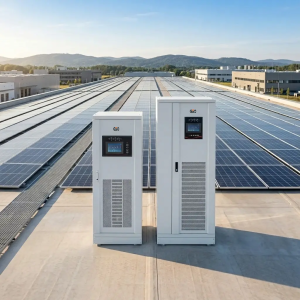

A hybrid solar inverter system is best understood as a set of connected paths, not a single box on a wall. Solar panels, battery storage, household or business loads, and the utility grid each meet at a control point. At GSOpower, Our GST Series can serve as that point in a split-phase installation, with parallel configurations described for larger arrangements. The distinction becomes important when a project calls for a three phase hybrid inverter: the electrical design must create the required output, not merely include an inverter described as hybrid.
Four Connections Give the System Its Shape
The solar array sends DC electricity to the inverter’s PV input. Maximum power point tracking adjusts how the panels are operated as sunlight changes. A connected battery adds a second DC source and a place to store energy for later. On the AC side, the building’s selected circuits need usable power, while the grid may supply electricity or receive it when the installation and local rules permit.
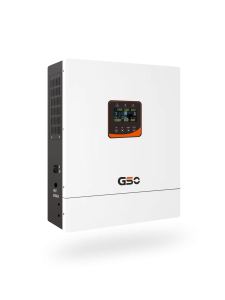
The GST is the coordinating device at these connections, but it does not include the panels or battery. Our GST Series uses a nominal 48 V battery platform and supports lithium, lead-acid, and user-defined battery settings. Matching the chosen battery’s voltage, charge limits, and communication method to the inverter is a design task, not a detail to settle after delivery.
Settings Change the Same Hardware Into Different Systems
Imagine two sites with identical panels and inverters. One wants its battery charged mostly by daytime solar; the other wants a full reserve before a predictable period of unreliable grid service. Their hardware could be similar, yet the control priorities would produce different results. The GST lists solar-only, solar-priority, grid-priority, and hybrid charging modes to address these different objectives.
An operator chooses the priority, and the inverter responds as solar production and load demand change. For example, the system may serve current loads while available solar charges a battery, then draw on stored energy after production falls. Grid charging may also be part of the plan when the selected mode allows it. No mode can overcome an undersized battery or a shaded array, which is why settings must follow the site’s energy profile.
Outage Operation Has Its Own Boundaries
When utility power disappears, the backed-up circuits have to be isolated from the grid. The inverter can then supply them using available battery energy, subject to its output rating and the battery’s charge. The GST specifications list a typical 10 ms inverter and bypass switching time, but the performance of individual appliances depends on the complete installation.
The product page also describes PV-only startup without a battery. That could allow supported loads to operate in daylight when storage is absent, although passing clouds and low sun make it an unsuitable substitute for planned battery backup. The questions are therefore practical: which circuits stay connected, how much power can they draw together, and what source remains after sunset?
The AC Output Must Match the Building
A single GST unit is listed with split-phase 120 V and 120/240 V output. The current product range includes rated outputs of 6.6 kW, 8.5 kW, 10.5 kW, and 12.5 kW. A building with three-phase distribution has a different output requirement. The GST page describes up to nine units operating in parallel, including configurations for three-phase AC, but an individual unit is not itself a three phase hybrid inverter.
That difference affects more than terminology. A multi-unit design must assign inverters and loads to the appropriate phases, specify protective equipment, and confirm the approved wiring arrangement. If a three phase hybrid inverter is being considered for motors or commercial circuits, an installer should map steady loads and starting surges before selecting the unit count. Simply multiplying rated outputs does not explain how much any one phase can carry.
Why Coordinated Design Matters
Solar production rarely coincides perfectly with demand. A hybrid system offers a way to use some energy immediately, store some for later, and call on the grid when needed. In an outage, a correctly designed backup path may preserve selected operations. Those outcomes depend on the whole system: array size, battery capacity, controls, and circuit selection have to support the same objective.
The GST adds communications through RS485, CAN, USB, and dry contacts, while Wi-Fi or 4G is listed as an external module. Such interfaces can help the inverter exchange information with compatible equipment and make monitoring possible. Physical placement matters too; its IP20 rating and forced-air cooling call for a protected, ventilated location. Even an excellent control scheme cannot make up for incompatible connections or unsuitable installation conditions.
Conclusion
Draw the system before judging its headline features. Show the PV input, battery connection, grid interface, and loads that must receive power; then mark what changes after sunset and during an outage. For a three phase hybrid inverter project, the drawing also needs to show how supported parallel units form the required AC output.
That is the conversation we want customers to have when considering GSOpower equipment: where solar enters, when storage charges, what remains powered, and how the output is arranged. Those answers reveal whether one GST split-phase unit or an engineered parallel configuration belongs in the finished system.