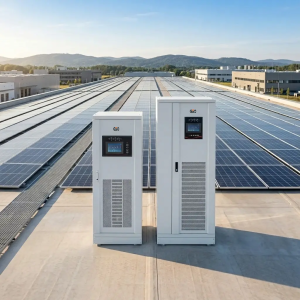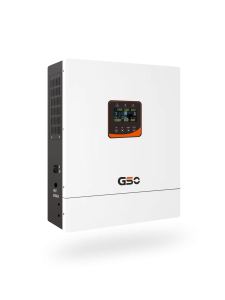

Businesses exploring commercial scale battery storage usually have a clear goal: reduce demand charges, keep essential equipment online, or use more solar power on site. A successful project starts with the facility’s load profile and operating schedule, then matches capacity, inverter power, installation space, safety controls, and expansion plans. This guide explains the decisions that turn commercial battery storage into a useful operating asset.
What commercial battery storage does
Commercial battery storage captures electricity when it is available and releases it when the facility needs it most. A solar array can charge the batteries during high-production hours, while the grid can charge them during a low-cost tariff period. The stored energy can then support loads during evening operations, a demand peak, or a utility outage.
The battery’s energy capacity is measured in kilowatt-hours and determines how long it can supply a load. Its power rating, measured in kilowatts, determines how much equipment can run at one time. Peak shaving may need high discharge power for a short period, while backup usually needs a larger energy reserve. These are different design targets, even when both projects use commercial scale battery storage.
How to size a system
Begin with twelve months of interval utility data when available. This provides a much clearer picture of how electricity is actually used across different days, seasons, and operating conditions. Review the data to identify demand peaks, the typical daily load shape, operating hours, and periods when electricity consumption rises sharply. These patterns help determine whether the battery is mainly needed for peak shaving, solar self-consumption, backup power, or a combination of these functions.
For backup planning, identify the circuits and equipment that must remain online during a grid outage. This may include servers, lighting, communications equipment, refrigeration, security systems, production controls, pumps, or other essential machinery. Each critical load should be recorded together with its normal power requirement and the expected runtime during an outage. Equipment does not necessarily need to operate for the same amount of time, so separating essential loads from lower-priority loads can help avoid oversizing the battery system.
Motor-driven equipment requires additional attention. Pumps, compressors, fans, and HVAC systems can draw significantly more power when starting than they consume during normal operation. These temporary starting currents can place a high demand on the inverter even if the battery has sufficient energy capacity. As a result, both continuous power and short-duration surge capability must be considered when selecting the battery and inverter.
A simple starting estimate for backup capacity is to multiply the total critical load in kilowatts by the required backup time in hours. For example, a 50 kW critical load operating for two hours would require at least 100 kWh of usable energy before other factors are considered. The calculation should then be adjusted for usable depth of discharge, inverter efficiency, temperature effects, battery degradation, and an appropriate emergency reserve.
Peak-shaving calculations focus more heavily on power. Compare the battery’s available discharge power with the demand threshold the facility wants to avoid exceeding. The battery must be able to respond quickly enough and continue discharging for the duration of the peak.
These calculations provide an initial sizing estimate rather than a final system design. A qualified engineer should validate the proposed battery capacity, inverter rating, protection equipment, electrical integration, local codes, safety requirements, and applicable utility interconnection rules before installation.
Why rack mounted batteries fit commercial sites
Rack mounted batteries use vertical cabinet or server rack space instead of spreading modules across the floor. This format suits telecom rooms, data centers, UPS installations, factories, and commercial solar projects where floor area and service access are limited. Standardized racks simplify expansion, cable organization, and maintenance.
Commercial scale battery storage in a rack format can be installed in stages. A business may begin with capacity for essential backup or a modest demand reduction target, then add modules after reviewing operating data. The rack enclosure, ventilation, fire protection, and working clearances still need to suit the site.
Product Spotlight
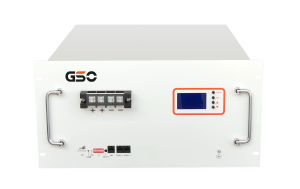
At GSOpower, our GBP-R Series Rack Type Lithium Iron Phosphate Battery is built for commercial and industrial installations that require a compact, modular energy reservoir. It is available on 24V, 48V, and 51.2V platforms, with nominal module energy from 2.56 kWh to 16.1 kWh. The series uses LiFePO4 cells and is rated for more than 5,000 cycles at 80% depth of discharge, with a stated design life of ten years.
We designed the GBP-R for practical installation work. A built-in LCD displays battery status and lets an installer select the inverter communication protocol directly on the unit. Front-access wiring means routine service does not require removing the battery from the rack, while on-screen fault codes can support faster diagnosis. CAN and RS485 communication help connect the modules with compatible hybrid inverters, UPS equipment, and energy management systems.
The series supports automatic addressing when modules are connected in parallel. Up to 16 units can be combined, allowing a project to grow from a small 2.56 kWh building block to an array above 256 kWh within the supported configuration. Some 48V 200Ah models can be customized for a 1C charge and discharge rate when a project needs faster energy delivery. The standard enclosure is IP20, so indoor placement and appropriate environmental controls are required.
Where commercial battery storage is used
In a factory, batteries can charge during low-cost hours and discharge when production approaches a demand-charge threshold. In a retail building, they can absorb midday solar output and support evening lighting, refrigeration, and point-of-sale equipment. In a data center or telecom site, the battery can provide UPS support until another backup source starts.
Commercial scale battery storage also supports microgrids and remote facilities. When the grid is weak or unavailable, a battery can coordinate with solar generation and an inverter to balance changing loads. Autonomy depends on solar energy, battery capacity, weather, and selected loads. A generator may still be useful during long, low-sun events.
Safety and integration checks
Every project needs a battery management system that monitors cell voltage, temperature, charging, and discharging. Confirm BMS communication with the chosen inverter or power conversion system, and review short-circuit protection, emergency shutdown, fire detection, cable routing, and responder access.
The site assessment should cover temperature and humidity. GBP-R charging and discharging limits differ, and the recommended operating range is narrower than the storage range. Commissioning should include communication checks, alarm tests, operating-mode verification, and staff documentation.
Measuring return on investment
The value of commercial battery storage comes from several services. Savings may include lower demand charges, greater solar self-consumption, reduced peak-period purchases, and avoided downtime. Calculate these benefits using the facility’s tariff, production schedule, outage history, and cycling pattern, including installation, maintenance, replacement reserves, and financing.
Conclusion
Commercial battery storage works best when the system has a defined job, measurable operating data, and a design that can grow with the facility. Commercial scale battery storage can support peak shaving, solar self-consumption, UPS continuity, and microgrid operation when capacity and power are selected carefully. At GSOpower, we help customers evaluate rack-mounted LiFePO4 options, communication requirements, and expansion plans so the battery installation supports dependable day-to-day operations.