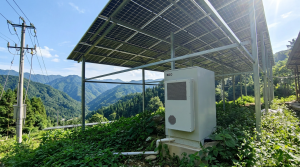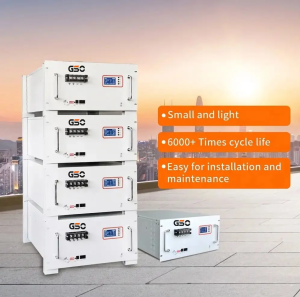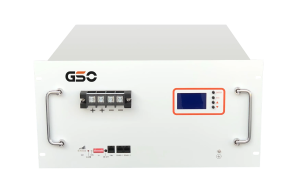

A LiFePO4 solar battery is best understood not as a standalone box, but as the storage part of a larger power system. We will answer what this battery does, why lithium iron phosphate is used, and where it fits in a modern solar-storage setup.
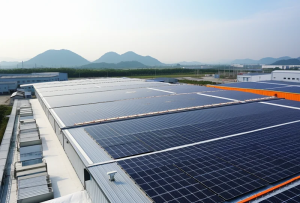
Where the Battery Fits
Solar panels produce electricity when sunlight is available, while household or business demand does not necessarily follow the same schedule. Solar battery storage bridges that timing gap by storing electrical energy and making it available later. In a typical system, PV power can be used to charge the battery, while an inverter manages the conversion between the battery’s stored DC energy and the AC power used by loads.
Our starting point at GSOpower is therefore the complete system rather than the cell alone. It also presents residential systems with wall-mounted LiFePO4 batteries and hybrid inverters, alongside larger commercial and industrial configurations.
Why LiFePO4 Is Used
LiFePO4 stands for lithium iron phosphate, a lithium-ion battery chemistry widely used for stationary energy storage. Its relevance here comes from its suitability for repeated charge and discharge in an energy-storage application. The chemistry is used in battery cells, but a finished storage system also needs electronic controls and protection.
A LiFePO4 solar battery therefore contains more than electrochemical cells. Battery modules normally work with a Battery Management System, or BMS, which monitors and manages cell operation. Those controls are essential because reliable storage depends on coordinated operation at the system level.
What Happens During a Normal Cycle
Imagine a home producing more solar electricity at midday than it needs. Instead of sending all surplus energy elsewhere, the storage system can direct available power into the battery. Later, when solar production falls, stored energy can be discharged to support the load.
Operating logic can also respond to electricity prices or grid conditions. Charging during off-peak periods and discharging during peak-demand periods is known as valley filling and peak shaving. It also identifies operating modes such as PV priority, load priority, and grid-tie priority. Exact behavior depends on system configuration, inverter settings, and local operating requirements.
What Makes a Usable Storage System
Solar battery storage must also be matched with an inverter that communicates correctly, while the installation environment must suit the equipment design. The reference notes CAN/RS485 communication and compatibility with more than 65 inverter models for the referenced solution family. It also distinguishes indoor and outdoor enclosure requirements.
Capacity should follow the actual load profile and the purpose of storage. A household seeking backup power may focus on which loads must remain available and for how long. A commercial user may instead care about shifting energy away from expensive periods or reducing peak demand. Starting with the intended operating objective makes battery sizing much more meaningful.
Cycle life is another specification worth reading carefully. It describes how many charge-discharge cycles a battery is designed to support under defined conditions, rather than guaranteeing a fixed number of years in every installation. LiFePO4 storage options range from 5,000 to more than 25,000 cycles, though individual products may have different specifications.
Where This Chemistry Fits
For residential storage, a battery storage system can be configured as a wall-mounted or stacked battery and paired with a hybrid inverter. Home storage capacities range from 5 kWh to 30 kWh across the residential category. These systems are designed to store solar energy for later household use and can be expanded in modular configurations where the design permits.
Commercial and industrial storage uses the same underlying chemistry in larger architectures. Rack-mounted battery clusters can be combined with PCS equipment, while liquid-cooled cabinets and containerized systems can support higher-power projects. Whether it’s for factories, data centers, or telecom applications, C&I solutions position the battery as one component within a wider power-conversion and energy-management framework.
A Practical Way to Evaluate One
Start with the load, not the marketing label. List the equipment that must run, estimate when it operates, and determine whether the goal is self-consumption, backup, peak shaving, or another defined function.
Next, check usable capacity, inverter compatibility, communication interfaces, installation conditions, and the BMS architecture.
Modular design, remote monitoring, and system-level support are also key considerations. These details matter because a battery is installed as part of an electrical system—not used in isolation.
At GSOpower, we approach storage around the intended application, matching residential backup, commercial energy management, or larger renewable-energy projects to the appropriate system architecture.
The Quick Takeaway
The simplest definition is also the most useful: this battery chemistry stores electricity so solar power can be used when generation and demand do not coincide. LiFePO4 refers to the cell chemistry, while the complete storage solution also involves the BMS, inverter or PCS, controls, protection, and installation environment.
For a first evaluation, focus on what the system needs to accomplish, then match capacity, power, communications, enclosure, and operating strategy to that objective. We find that approach avoids treating battery chemistry as the only decision and gives buyers a clearer path from solar generation to dependable stored energy.