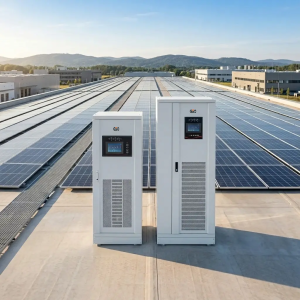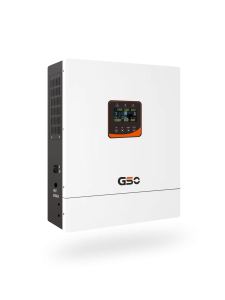

Specifications, not product labels, decide whether an inverter fits a building. A hybrid solar power inverter can coordinate solar panels, a battery, and grid power, yet its AC output may be split-phase rather than three-phase. GSOpower’s GST Series shows why the distinction matters: each listed unit has split-phase output, while the product page describes three-phase output through supported parallel configurations. Anyone comparing a three phase hybrid inverter should identify the required output arrangement before looking at wattage or charging features.
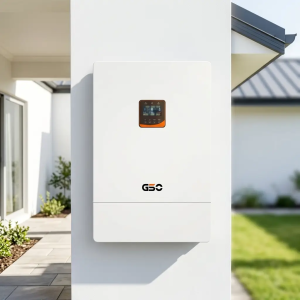
Check the AC Output Arrangement
The GST specifications list 120 V and 120/240 V AC output for the split-phase models. That is not the same as three separate AC phases from one enclosure. If a site has three-phase service or three-phase motors, ask for the proposed parallel wiring diagram and confirmation that the configuration supports its actual loads. The phrase three phase hybrid inverter should never substitute for a drawing of how power reaches the distribution board.
For a home with split-phase service, one GST unit may be the relevant starting point. For a larger site, multiple units may be considered, subject to the series’ approved configuration. Either way, service voltage, frequency, circuit layout, and local interconnection requirements need to agree with the selected hardware.
Compare Continuous Output With Starting Demand
Four GST models are listed with rated AC outputs of 6.6 kW, 8.5 kW, 10.5 kW, and 12.5 kW. Rated output indicates sustained power delivery under specified conditions. Appliances with motors can briefly demand more when starting, so a load schedule should include both steady operation and short peaks. This is especially relevant for pumps, compressors, and workshop equipment.
Do not add up the inverter ratings on a parallel proposal and assume every circuit can draw that total freely. The way units are assigned to phases, the design of the distribution system, and operating limits all affect usable capacity. For a three phase hybrid inverter installation, the installer should document anticipated load on each phase and the behavior when a large motor starts.
Match the PV Array to the Input Limits
Panel strings must stay inside the selected model’s permitted DC voltage and current ranges. The GST page gives model-dependent limits for PV array power, input current, and maximum open-circuit voltage. Maximum power point tracking, or MPPT, then adjusts the electrical operating point to suit changing sunlight. Its listed tracking efficiency does not mean every watt generated by the panels reaches the loads or battery; conversion and wiring losses still exist.
A useful specification review includes the panel model, number of panels per string, expected cold-weather voltage, and roof orientation. Two arrays with the same total wattage can behave differently at the inverter terminals. Confirm the string design against the actual GST model rather than choosing panels by total watts alone.
Verify Battery Voltage Charging and Communication
Our GST Series uses a nominal 48 V battery platform, with a listed operating range of 40 V to 60 V. It has settings for lithium, lead-acid, and user-defined batteries. Those broad categories do not establish compatibility by themselves. The battery’s allowed charge current, voltage limits, and communication method must be checked alongside the inverter’s settings and connectors.
Charging behavior matters as much as electrical fit. The GST provides solar-only, solar-priority, grid-priority, and hybrid charging options. Choose a mode that reflects whether the site values daytime self-consumption, a reliable backup reserve, or charging at particular grid tariff periods. A three phase hybrid inverter project with several units needs that strategy applied consistently across the system.
Examine Backup Claims Carefully
The product specifications give a typical 10 ms inverter and bypass switching time. That number is worth discussing, but it cannot tell you which appliances remain powered during an outage. The answer comes from the backup circuits, available solar or battery energy, inverter settings, and safe isolation from the grid.
GST equipment also supports PV-only startup without a connected battery. Sunlight can therefore be an emergency source for supported loads, provided the proposed configuration allows it. It is not equivalent to nighttime backup, and output can change rapidly with weather. If continuity is important, specify a compatible battery and the minimum charge that should be preserved.
Review Expansion Interfaces and Installation Conditions
The series is described as supporting as many as nine inverters in parallel, including arrangements for three-phase AC output. Before treating that as an expansion plan, obtain a model-specific design showing unit count, phase assignment, protection equipment, and any limits that apply to the site. Future growth is useful only when the first installation leaves a documented route to it.
RS485, CAN, USB, and dry-contact interfaces appear in the GST specifications; Wi-Fi or 4G is listed as an external module. Confirm which interfaces the selected battery and monitoring setup will use. The inverter also carries an IP20 rating and uses forced-air cooling, so placement must provide protection and airflow. Request the current installation and approval documents for the project’s jurisdiction before ordering.
Conclusion
The strongest specification sheet is the one that answers the site’s questions precisely. Output arrangement comes first, followed by continuous and starting power, PV string limits, battery compatibility, backup design, and the conditions for expansion. A three phase hybrid inverter requirement makes the phase diagram and approved parallel configuration particularly important.
Bring the GST details from us, GSOpower, to the installer and ask for a model-specific wiring plan rather than relying on a category name. With the electrical service, panels, battery, and protected loads checked together, the final choice can be based on an engineered fit instead of an assumption.